

An outdoor ceiling fan with light is a weatherproof fixture that combines airflow and illumination in a single unit, rated as either “damp” (for covered, sheltered spaces) or “wet” (for open patios, gazebos, and areas exposed to rain or splash) so it can operate safely outdoors. For Bakersfield homeowners, it solves two problems at once: keeping a patio comfortable during triple-digit summer evenings and extending usable outdoor time after dark.
Standing on a patio in July with the sun still baking the concrete at 8 PM, most homeowners land on the same conclusion: this space needs air moving and it needs light once the sun drops. That’s exactly why this fixture has become one of the most searched-for upgrades for patios, covered porches, and pergolas across Kern County. But choosing one raises real questions: Will it rust in valley heat and dust? Can it handle wind gusts? Is it safe to wire near a wet area? And does a “damp-rated” fan actually hold up outside, or do you need a fully wet-rated model instead?
Why an Outdoor Ceiling Fan With Light Solves More Than One Problem
Homeowners rarely search for this fixture out of curiosity. Usually there’s a triggering moment — a summer barbecue that ended early because the patio was unbearable after sunset, a string of cheap clip lights that finally gave out, or a new pergola that suddenly feels unfinished without airflow overhead. The appeal of combining a fan and a light fixture is practical:
- One electrical run instead of two. Rather than wiring a separate porch light and a separate fan, you’re pulling power to a single junction box.
- One design decision instead of two. You’re not trying to match a fan’s finish to a lantern’s finish; it’s already one cohesive piece.
- Extended usable hours. The fan handles the heat of the afternoon; the light extends the space into the evening.
- Better mosquito control. Moving air genuinely reduces mosquito activity near seating areas, since mosquitoes are weak fliers.
The mindset shift worth making early: this is not the same purchase as an indoor ceiling fan. Outdoor units are built or should be built to handle temperature swings, blowing dust, and occasional moisture, all of which are routine in a Bakersfield summer and the foggy Tule mornings of winter.
Understanding “Wet-Rated” vs. “Damp-Rated”: The Detail Most Buyers Miss
This is the single biggest source of confusion, and it’s where a lot of well-meaning DIY installs go wrong. UL (Underwriters Laboratories) certifies outdoor fans in two distinct categories:
| Rating | Where It Belongs | Moisture Exposure | Typical Use Case |
| Damp-Rated | Covered porches, screened patios, enclosed lanais | Humidity and condensation, but no direct rain | Under a solid roof overhang |
| Wet-Rated | Open patios, gazebos, pergolas, poolside areas | Direct rain, sprinkler overspray, blowing moisture | Anywhere water can physically land on the fixture |
A waterproof outdoor ceiling fan with light meaning a properly wet-rated unit is the only safe choice for any spot exposed to direct rain, pool splash, or irrigation overspray. Installing a damp-rated fixture in a wet location isn’t just a warranty violation; it’s a genuine electrical hazard, since moisture intrusion into the motor housing or light kit can cause corrosion, short circuits, and in worst cases, fire risk.
If there’s any doubt about which zone your patio falls into, always size up to wet-rated. It costs a little more upfront and eliminates the guesswork.
Materials That Actually Survive Kern County Weather
Between the summer heat that regularly climbs past 100°F, dry winds carrying dust off the valley floor, and the occasional cold, damp winter morning, cheap materials degrade fast outdoors. Look for:
- Motor housings sealed against dust and moisture : sealed ball bearings resist the fine grit common in valley air.
- Rust-resistant blades : ABS plastic composite, weatherproof engineered wood, or powder-coated aluminum outperform painted metal, which tends to bubble and peel within a couple of summers.
- Stainless steel or galvanized hardware : standard steel screws and brackets will rust within a season or two of sun and heat exposure.
- UV-stabilized finishes : plastic and composite components without UV stabilizers turn brittle and discolor under constant sun.
A fan that looks identical to an indoor model but lacks these details is usually a repainted indoor fan being marketed loosely as “outdoor use” a common and frustrating trap for first-time buyers.
Sizing an Outdoor Ceiling Fan With Light Correctly
Undersized fans move air weakly and look visually wrong on a large patio; oversized fans overwhelm a small covered porch and can feel more like a wind tunnel than a comfort feature. A simple sizing reference:
| Patio or Porch Size | Recommended Fan Blade Span |
| Small porch (up to 75 sq ft) | 29″ – 36″ |
| Medium patio (76 – 144 sq ft) | 42″ – 48″ |
| Large patio (145 – 225 sq ft) | 50″ – 54″ |
| Extra-large patio or pergola (225+ sq ft) | 56″ – 72″, consider multiple fans |
For rooms with especially high ceilings think open pergolas or covered patios with vaulted overhangs a downrod is essential. Standard downrod length puts the fan blades roughly 8–9 feet above the floor for the best airflow-to-clearance ratio; too high, and the airflow disperses before it reaches anyone sitting below.
Light Kit Options and What They Mean for Outdoor Use
The “with light” half of the equation deserves its own attention, since not every light kit is built to the same standard.
- Integrated LED kits : Most modern outdoor ceiling fans with lights ship with a sealed LED module rather than a standard bulb socket. This is generally the safer and longer-lasting choice outdoors, since there’s no exposed socket for moisture to enter.
- Bulb-compatible fixtures with a sealed glass shade : Still weatherproof if properly gasketed, but check that the glass shade has a rubber or silicone seal, not just a friction fit.
- Remote or smart app control : Increasingly common, and genuinely useful outdoors where a wall switch may be inconveniently placed relative to seating.
- CCT-adjustable light temperature :Some higher-end fixtures let you shift between warm and cool white tones, useful for entertaining versus everyday ambient lighting.
Whichever kit you choose, confirm the wattage and bulb type match what the fixture is rated for. Overdriving an LED module with the wrong replacement bulb is a common cause of premature failure.
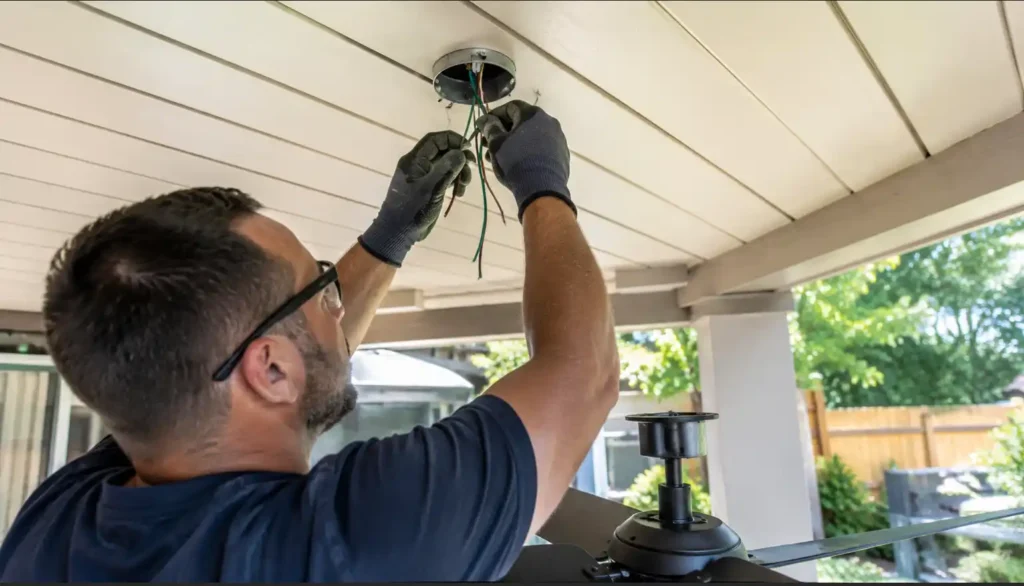
The Installation Problem Most Homeowners Underestimate
Here’s where the DIY mindset usually runs into a wall. Buying the right outdoor ceiling fan with lights is only half the job the electrical side is where things get genuinely risky if done incorrectly:
- The junction box must be rated for fan support. A standard light-fixture box is not engineered to hold the ongoing torque and vibration load of a spinning fan; it needs a fan-rated box secured directly to a joist or brace.
- Outdoor wiring needs weatherproof connections. Wire nuts alone aren’t enough outside connections need to be sealed inside a weatherproof, gasketed fixture box.
- GFCI protection is required by code for outdoor circuits in most jurisdictions, and for good reason: it cuts power instantly if moisture creates a ground fault.
- Wire gauge and circuit capacity matter, especially if the fan and light are running off an existing patio circuit that’s already carrying other loads.
This is exactly the kind of job where a small mistake an under-supported box, a non-weatherproof splice, a missing GFCI doesn’t show up immediately. It shows up eighteen months later as a flickering light, a wobbling fan, or worse, a tripped breaker every time it rains. If you’re planning this upgrade, our Ceiling Fan Installation service handles exactly this kind of outdoor-rated wiring and mounting work safely and to current code. Ceiling Fan Installation Bakersfield
For homeowners who are also rethinking their broader outdoor lighting plan landscape lighting, security lighting, or a full patio lighting layout it’s worth handling both projects together, since the electrician is already running conduit and pulling permits for the area. Our Lighting Installation team frequently pairs fan wiring with a full outdoor lighting upgrade in a single visit. Lighting Installation Bakersfield
Common Pain Points and How to Actually Solve Them
“My old outdoor fan is wobbling and noisy.” Usually this traces back to either an unbalanced blade set (dust and pollen accumulate unevenly on outdoor blades) or a loosened mounting bracket from vibration over time. A quick balancing kit fixes minor wobble; persistent wobble after balancing usually points to a failing motor or a mount that was never properly torqued during the original install.
“The light flickers every time it’s humid or after rain.” This is a strong sign that water has found its way into a connection point that wasn’t properly sealed, or the fixture wasn’t rated for the exposure it’s getting. Flickering after moisture exposure should be treated as a safety issue, not a cosmetic annoyance it needs to be inspected before it’s used again.
“I want a fan but I’m worried about my existing patio circuit.” This is a legitimate concern in older Bakersfield and Oildale homes, where patio circuits were sometimes added decades ago without today’s load requirements in mind. Rather than guessing, an on-site load assessment tells you definitively whether the circuit can handle a new fan and light, or whether a dedicated circuit makes more sense.
“Do I need a permit for this?“ In most cases, adding a new circuit or a new fixture box for an outdoor ceiling fan requires an electrical permit in Bakersfield and surrounding Kern County jurisdictions, particularly for new wiring runs. Skipping this step can complicate a future home sale inspection.
Related Article You Must Read : Do I Need a Permit for Electrical Work? A Bakersfield Homeowner’s Guide
Comparing Fan Types for Outdoor Spaces
| Fan Type | Best For | Pros | Watch-Outs |
| Standard flush-mount | Low-clearance covered porches | Compact, low ceiling profile | Slightly reduced airflow vs. downrod mount |
| Downrod-mounted | Vaulted or tall patio ceilings | Stronger airflow, better sightlines | Needs correct drop length for clearance |
| Dual-motor / large-diameter | Wide, open pergolas | Covers larger seating area evenly | Higher upfront cost, heavier mounting demands |
| Damp-rated only | Fully covered, enclosed porches | More design variety, often lower cost | Not safe for any open-air or poolside exposure |
Maintenance Tips That Extend the Fixture’s Lifespan
- Wipe down blades monthly during peak season; accumulated dust throws off balance and strains the motor.
- Inspect the light seal and gasket twice a year, especially before and after the rainy season.
- Tighten mounting screws annually vibration loosens hardware gradually even on well-installed fans.
- Turn the fan off during high wind advisories; even wet-rated fans aren’t designed to spin safely in extreme gusts.
- If the fan has a reversible motor, switch direction seasonally counterclockwise for summer cooling, clockwise (low speed) for gentle winter air circulation.
Frequently Asked Questions
Can I install a regular indoor ceiling fan outside if it’s under a covered patio? No. Even under full cover, humidity and temperature swings will corrode an indoor-rated motor over time. Always choose at minimum a damp-rated fixture for any outdoor location.
What’s the real difference between damp-rated and wet-rated fans? Damp-rated fans handle humidity and condensation but must stay out of direct rain or water contact. Wet-rated fans are sealed to handle direct rain, splashing, and open-air exposure the only safe choice for uncovered patios, gazebos, and poolside areas.
How much does it cost to install an outdoor ceiling fan with light? Cost depends on whether existing wiring can be used or a new circuit is required, plus the fixture’s price point. A straightforward swap onto existing wiring is typically far less expensive than adding a new dedicated circuit with a permit.
Do outdoor ceiling fans with lights need GFCI protection? Yes. Outdoor electrical circuits, including those powering fans and lights, require GFCI protection under current electrical code to prevent shock hazards from moisture exposure.
Can I add a light kit to an existing outdoor fan that doesn’t have one? Sometimes, if the fan model supports a compatible light kit accessory and the existing wiring supports the added load. This should be evaluated by a licensed electrician rather than assumed.
How long do outdoor ceiling fans with lights typically last? A well-built, correctly rated unit that’s properly maintained can last 8–12 years or more; cheaper units in harsh sun exposure often fail within 3–5 years due to UV and heat degradation.
Getting It Installed the Right Way
Choosing the right outdoor ceiling fan with light is a design decision. Getting it wired safely is an electrical one, and the two shouldn’t be treated the same way. Between UL wet ratings, GFCI requirements, fan-rated junction boxes, and local permitting, this is a project where professional installation protects both your investment in the fixture and your home’s safety.
Related Post You Must Know: How to Install a Ceiling Fan Without Existing Wiring: The Complete Bakersfield Homeowner’s Guide
If you’re dealing with an aging patio circuit, unsure whether your space is classified as damp or wet exposure, or simply want the fixture mounted correctly the first time, our licensed team handles this regularly across Bakersfield, Oildale, and the surrounding Kern County communities. For a broader look at what a project like this typically costs locally, our related post on Hourly Rate Electrician: What Bakersfield Homeowners Actually Pay breaks down real pricing homeowners have paid for similar residential electrical work in 2026. Hourly Rate Electrician: What Bakersfield Homeowners Actually Pay
For urgent issues a flickering fixture, a tripped breaker after rain, or exposed wiring near a wet area — our 24 Hour Electrician service is available for same-day response. 24 Hour Electrician Bakersfield